Start with the child, not the benefit claim
The best coloring book is one a child wants to use and can access comfortably. Covers often promise calm, focus, confidence, fine-motor growth or mindfulness. These are marketing categories, not guaranteed outcomes. Look inside the book and judge the actual task.
Ask whether the child likes the theme, wants a story or independent pages, prefers realistic images or patterns, and enjoys small detail. At ages 6–10, children’s interests and motor comfort vary widely. An age label cannot replace looking at the page.
Match page complexity
Large sections and strong boundaries are easier to navigate quickly and with broad tools. Dense mandalas, thin lines and many tiny spaces require slower movement, visual scanning and persistence. Detail is not inherently better; it can be absorbing for one child and exhausting for another.
Preview three pages, including a typical middle page rather than only the easiest sample. If the child often presses hard or tires, test the intended pencils or crayons on similar paper. Coloring and Fine Motor Skills explains why tool and setup change the demand.
Check format and usability
- Pages lie flat or can be removed without tearing the image.
- Paper suits the intended crayons, pencils or markers.
- Images are printed clearly, with enough contrast.
- The reverse side is blank if bleed-through is likely.
- The book can be used without reading instructions above the child’s level.
- There is enough visual variety without dozens of nearly identical pages.
- Digital printables have a clear preview and do not require unnecessary personal data.
Story, prompt or open image?
Story-based books can invite sequencing and conversation, while stand-alone pages reduce reading and memory demands. Emotion prompts may help some families begin a discussion but can make quiet time feel instructional. This comparison of story-based and regular pages separates plausible uses from unsupported claims.
Look for optionality. A good prompt leaves room for the child’s answer and does not prescribe a “correct” emotion or moral. Children who love inventing may prefer images with blank space, speech bubbles or a place to add a scene.
Representation and emotional fit
Notice whether characters, families, bodies and cultures are represented respectfully and whether the book’s tone fits the child. “Calm-down” books should not shame anger, sadness or worry. Motivational slogans should not imply that positive thinking fixes disability, bullying, illness or unsafe situations.
Avoid pages that turn compliance into virtue or portray one appearance as normal. If the book addresses difficult topics, read it first. A coloring product is still content, and a soothing design does not make every message appropriate.
Choose for a real purpose
For travel, prioritize portability and low mess. For shared conversation, choose images that invite curiosity. For independent quiet time, reduce instructions. For a waiting room, include several levels of detail and other choices. For motor practice recommended by a professional, follow the specific goal rather than buying a generic “skill-building” label.
If the child does not want coloring, buy nothing. My Child Does Not Like Coloring explains why alternatives are equally valid. For a calm-down option, read what the research actually supports.
A five-minute selection test
- Show two or three sample styles.
- Let the child choose a theme and detail level.
- Try the intended tool on comparable paper.
- Ask whether the child wants a whole book or occasional single pages.
- Check that declining or stopping will be acceptable.
The best coloring books depend on the child’s intended use
When comparing coloring books for 6 year olds, look past the age label to the size of the spaces, amount of text and whether an adult will read alongside the child. Older children may still prefer broad, simple scenes. Complexity should reflect preference and comfort, not a requirement to choose a harder book each year.
For a story coloring book, inspect the narrative as well as the art. Check that the child wants the theme, that the language is usable and that coloring can remain optional. A representative preview is more informative than a list of promised benefits.
Bottom line
Choose a coloring book by interest, access, content and purpose. Treat developmental and therapeutic promises cautiously. A well-matched book makes the activity possible; the child’s voluntary engagement determines whether it becomes enjoyable or useful.
Frequently asked questions
How many pages are enough?
Quality and fit matter more than page count. A smaller book with varied, usable images may offer more value than hundreds of near-duplicates. Digital bundles should have representative previews so families can judge before purchase.
Are affirmations helpful?
Accurate, specific statements are less likely to invite disbelief than absolute slogans. “I can ask for help” is different from “I can do anything.” Avoid messages that make children responsible for changing circumstances beyond their control.
Should I choose by age label?
Use it as a rough signal only. Inspect detail, theme, reading level and tool demands. Two children of the same age may prefer very different complexity without either choice being more mature.
What makes a good preview?
It should show full, readable pages across the range of complexity, not only decorative mockups. Buyers should be able to evaluate content, print quality and appropriateness without seeing every page or exposing copyrighted files.
Inspect a real 22-page example
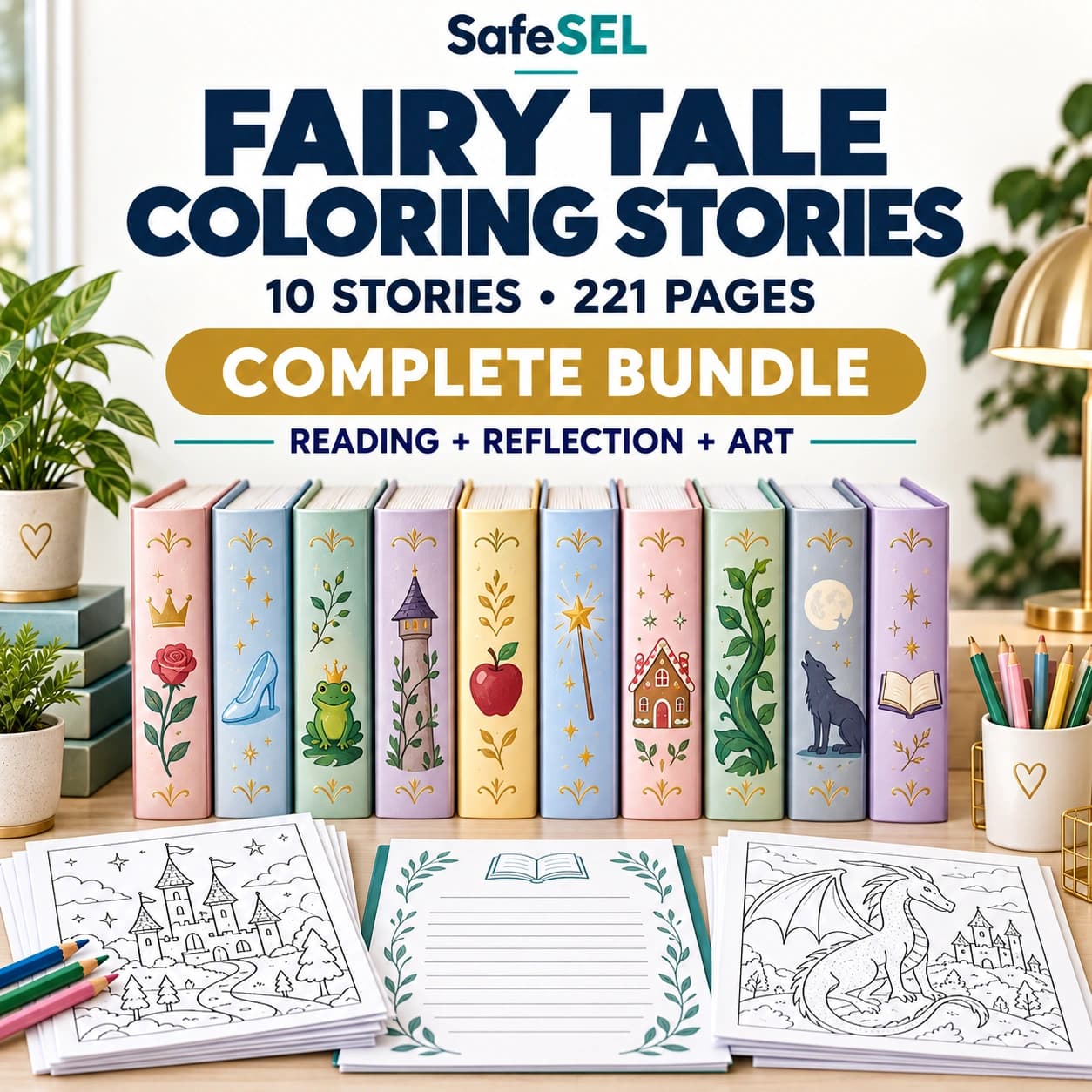
Use the readable gallery for The Emperor’s New Clothes Coloring Story to assess illustration detail, reading level and emotional themes before purchase. The story focuses on speaking up, honesty and independent thinking and includes US Letter and A4 print options.
Related guidance for the next step
Sources and further reading
- Quantifying Coloring Skills Among Preschoolers — Lee et al.; American Journal of Occupational Therapy (2024)
- Using a coloring activity to identify children's development of visual-motor integration: an application of artificial intelligence — Journal of NeuroEngineering and Rehabilitation (2025)
- Research progress on the relationship between fine motor skills and academic ability in children: a systematic review and meta-analysis — Li et al.; Frontiers in Sports and Active Living (2024)
- Overlooked advantages of interactive book reading in early childhood? A systematic review and research agenda — Noble et al.; Acta Psychologica (2023)
- Drawing conclusions: a re-examination of empirical and conceptual bases for psychological evaluation of children from their drawings — Thomas & Jolley; British Journal of Clinical Psychology (1998)
- International school-related sedentary behaviour recommendations for children and youth — Saunders et al.; International Journal of Behavioral Nutrition and Physical Activity (2022)