The meaningful difference is the activity structure
A regular coloring page usually presents one image or pattern. A story-based book places images in a sequence, often with characters, events and text. The second format can invite prediction, memory and conversation, but it also asks the child to coordinate more information. Neither format is automatically more educational or more calming.
Direct comparative research on commercial story coloring books for 6–10-year-olds is scarce. Evidence about interactive reading, wordless picture books, drawing and storytelling is relevant but indirect. It supports hypotheses about shared attention and conversation, not a claim that coloring a narrative improves literacy, emotional intelligence or therapy outcomes.
When a story may add value
A sequence can give purpose to the pages. Children may wonder what happens next, revisit a character’s choice or use color to distinguish settings and moods. A parent can follow the child’s lead with comments such as “You made this page darker than the last one” or “What do you think changed?”
Research on interactive book reading suggests that open questions, following the child and expanding what the child says may support engagement and learning. These findings mostly concern younger children and reading interactions, not coloring. The adult interaction may be the active ingredient; simply purchasing a story-themed book does not guarantee it.
When a stand-alone page may fit better
A child who wants a quiet, low-language activity may prefer a single scene or pattern. Story text and emotional prompts can turn rest into another lesson. Stand-alone pages also allow children to stop after one image without feeling they have abandoned a plot.
For regulation, simpler can be better. If the child is overloaded, a page with broad spaces and few decisions may be more usable than a multi-step narrative. See Can Coloring Help Kids Calm Down? for the difference between a settling activity and treatment.
Choose based on the child and the goal
- For independent quiet time, prioritize clear layout, preferred subject and manageable detail.
- For shared conversation, choose a story the child actually wants to discuss.
- For emerging readers, avoid making coloring conditional on reading every word.
- For children who love drawing, leave room to add characters, speech bubbles or a new ending.
- For children who dislike narratives, use patterns, factual themes or blank paper.
- For motor comfort, match tools and page detail regardless of format.
Do not decode the child’s colors
A child’s choice to color a character blue, black or multicolored is not a reliable emotional assessment. Reviews warn that drawings are too ambiguous to function as sole indicators of internal state. Ask curious, optional questions instead of assigning symbolic meanings.
If the child brings up a feeling, listen and respond to the words and context. How to Use Coloring to Talk About Feelings offers a low-pressure approach that avoids interrogation.
Story coloring books and picture books serve different routines
Picture books can be read together without asking the child to complete an art task. Story coloring books add pages the child can work on, but that extra activity may either suit the moment or interrupt the reading. When comparing educational books, ask whether you want to read a connected narrative, discuss one scene or offer independent coloring.
Preview a middle page as well as the opening. Check whether a child can enjoy the scene without reading the entire story and whether skipping a page causes confusion. A format that permits shared reading and optional coloring leaves more room for different interests.
Bottom line
Story-based coloring can combine sequencing, visual expression and shared conversation; regular pages can offer simplicity and independence. Research does not establish a universal winner. Choose the format that fits the child’s interest, reading load, need for structure and purpose in that moment.
Frequently asked questions
Do story coloring books improve reading?
That claim has not been established. Reading text and discussing a story can support a literacy interaction, but coloring itself may be incidental. Keep actual reading instruction and shared reading available rather than treating the product as a substitute.
Should the child color pages in order?
Only when sequence matters to the child or activity. Jumping around may preserve interest. If the goal is narrative ordering, invite the child to arrange or retell pages without making correct sequence a condition for coloring.
Can a story page be used for feelings conversations?
Yes, as an optional prompt. Talk about the character first and do not insist that the child identify with them. A fictional answer may remain fictional; it should not be interpreted as disguised disclosure.
What if the child changes the story?
That can be creative narrative work. Add speech bubbles, alternate endings or new characters if the child wants. The adult can stay curious without grading whether the revision follows the original moral.
See a complete story-coloring format
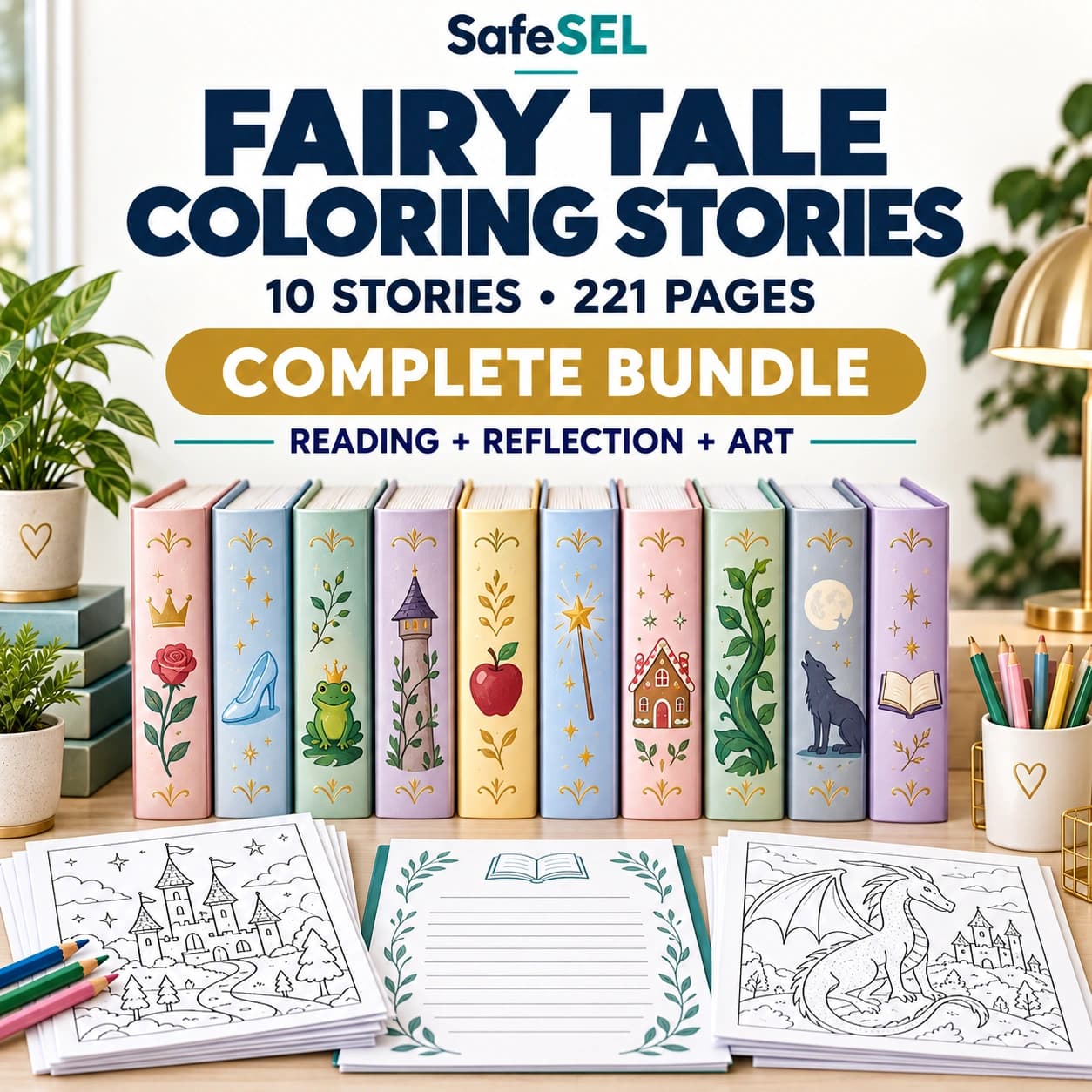
The Wild Swans Coloring Story is a 22-page example of a connected narrative with illustrated scenes, reflection pages and bonus coloring pages. Its gallery lets families inspect the sequence and reading demand before deciding whether a story-based format is preferable to stand-alone pages.
Sources and further reading
- Overlooked advantages of interactive book reading in early childhood? A systematic review and research agenda — Noble et al.; Acta Psychologica (2023)
- “Oh no! What happened?” an investigation of parent-child conversations about self-conscious emotions — Drummond et al.; Developmental Psychology (2023)
- Drawing and mutual storytelling to alleviate anxiety and improve emotional well-being in children in PICU: a randomized controlled trial — Köksal, Kilicarslan & Emeksiz; European Journal of Pediatrics (2025)
- Parallel developmental changes in children's production and recognition of line drawings of visual concepts — Long et al.; Child Development (2024)
- Drawing conclusions: a re-examination of empirical and conceptual bases for psychological evaluation of children from their drawings — Thomas & Jolley; British Journal of Clinical Psychology (1998)
- Quantifying Coloring Skills Among Preschoolers — Lee et al.; American Journal of Occupational Therapy (2024)