“We need ADHD parent training” can mean two different requests. A family may be looking for treatment with coaching and follow-up. A school counselor may be looking for a clear way to explain ADHD to a room of caregivers. Those needs overlap, but the same purchase will not necessarily meet both.
Before choosing a course, service or facilitator kit, identify who will attend, who will lead it and what happens after the presentation ends. A downloadable presentation can help someone teach. It cannot, by itself, provide assessment, individual coaching or a professional qualification.
What behavioral parent training involves
The CDC describes parent training in behavior management as an ADHD treatment that teaches caregivers practical ways to support behavior and relationships. It includes positive interaction, structure, reinforcement and practice between meetings. A therapist monitors progress and adjusts the plan. The CDC identifies it as the recommended first treatment choice for children under six with ADHD; a child's healthcare professional should guide treatment decisions.
“Behavioral parent training,” “parent behavior therapy” and “parent training in behavior management” may describe this treatment approach. The label alone does not establish a provider's competence or tell you what support a particular program includes. Ask how practice, feedback and progress review actually work. Read the CDC's explanation of parent training in behavior management.
ADHD courses for parents: what to check before enrolling
ADHD courses for parents can mean live coaching, recorded education or materials for someone else to teach. Before paying, ask who provides feedback, whether your child needs an assessment first, and what the fee includes. ADHD resources for parents can support a conversation with a provider, but a slide deck is not individualized ADHD parent coaching.
For a school event, label the invitation an ADHD workshop for parents and state that an adult facilitator leads it. Include a route for private questions after the group. Someone seeking treatment should not have to purchase educational files to learn where to ask for clinical help.
Three offers that can look similar online
A treatment service includes a relationship with a provider and an agreed clinical scope. A general parent education workshop offers explanation, examples and group practice. A facilitator kit supplies files that another person uses to lead a workshop. The last two can be useful without being substitutes for the first.
Look at the deliverables rather than the headline. Does “training” mean appointments, a video library, a live group, or a ZIP of slides and worksheets? Is feedback on the family's own situation included? Is the person buying the resource expected to deliver it? Clear answers prevent a parent buying facilitator files when what they needed was access to a clinician.
Questions a family can take to a provider
Ask: “How do you decide whether this is appropriate for our child?” Then ask what happens if the first plan is not helping. A practical conversation can also cover the provider's relevant training, the amount of between-session practice, accessibility, costs and how other caregivers might participate.
Bring one ordinary, specific example instead of trying to summarize every difficulty. “Homework is impossible” is hard to investigate. “After school, opening the homework folder takes twenty minutes; then we argue about the first instruction” gives the provider a sequence to ask about. Include what has already been tried and what made the situation easier or harder. This is preparation for a conversation, not a home diagnostic test.
What a school-led ADHD workshop can realistically do
A useful educational session might help caregivers understand the language used at a school meeting, notice the demands within a daily routine, and prepare questions for further support. It should not promise that one explanation or tool will resolve a child's difficulties.
For example, use a fictional morning routine: a child is asked to get dressed, find a bag and remember a permission slip. Invite the group to identify how many separate actions the instruction contains. Then ask participants to rewrite the adult's request and decide what information would be needed before choosing a support. The exercise teaches careful observation; it does not demonstrate a treatment outcome or establish why a real child struggles.
Allow participants to pass or discuss only the fictional example. A parent should not have to describe a difficult family incident publicly to take part. At the end, ask each person to write one question they want to bring to their child's support team, rather than a public pledge to “fix” behavior.
Keep the facilitator's role explicit
Teachers and counselors may have valuable knowledge about classroom demands and communication with home. That does not make every facilitator qualified to assess ADHD, advise on medication or deliver a named clinical program. Put the scope in the invitation and repeat it before questions begin.
An appropriate response to “Should we change the medication?” is to acknowledge the concern and direct the family to the prescribing professional, not to improvise advice. If a participant describes an immediate safety concern, use the setting's safeguarding or emergency procedure instead of treating the disclosure as a workshop case study.
Where the SafeSEL kit fits
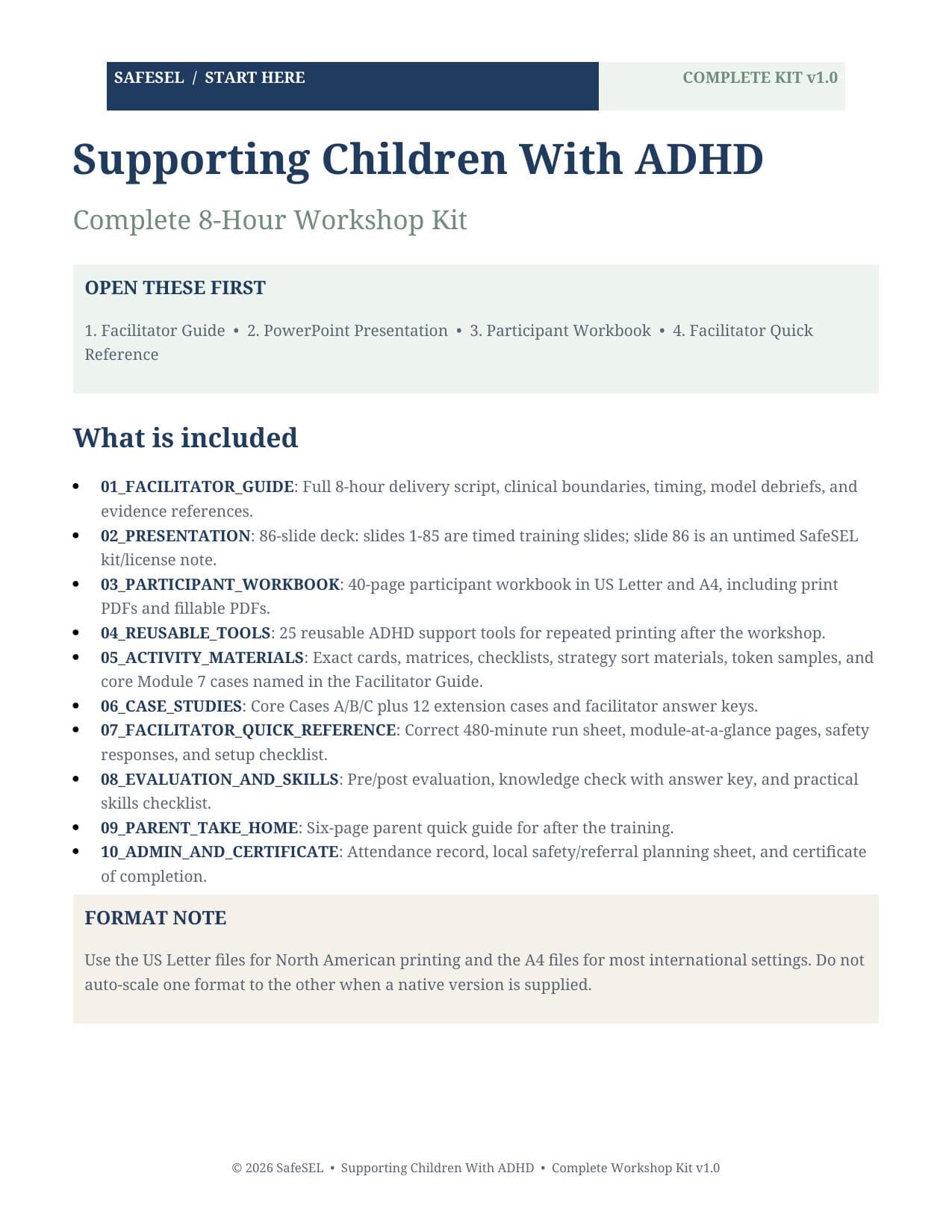
The Supporting Children with ADHD workshop kit is a digital resource for a facilitator: it includes an editable presentation, timed guide, workbook and practical tools. Adult parents and caregivers attend the workshop that the purchaser prepares and leads. The purchase is not a treatment appointment, a validated behavioral parent training program or accreditation.
If you are organizing several parent sessions, compare the parent workshop collection before choosing a topic. If your main task is arranging the meeting, use the parent education workshop planning guide. Families looking for treatment do not need to buy a facilitator kit first.
A useful decision before spending money
Finish this sentence: “After this purchase, I need someone to…” If the answer is “work with our family and review our progress,” look for an appropriate service. If it is “give me organized materials so I can lead an educational group within my role,” a facilitator kit may fit. Making that distinction matters more than choosing the offer with the longest list of files.
Related guide: Parent Workshop Topics for Schools: Choosing a Useful Focus