The slides are finished. The room is booked. Then someone asks a personal question ten minutes into the session, the activity takes twice as long as expected, and the final discussion disappears. A useful parent workshop plan makes room for those realities before delivery day.
The process here is for general educational workshops led by people working within their competence. It is not a protocol for group therapy. The sample 90-minute agenda is an original planning example, not a compressed version of any SafeSEL eight-hour workshop. When using a purchased curriculum, follow its actual sequence and adaptation guidance.
Write the outcome as something participants can do
“Understand child behavior” is too large to plan against. “Use a fictional example to distinguish an immediate response from a later conversation” is observable and teachable. Write one central outcome, then remove activities that do not support it.
Imagine a workshop about everyday transitions. You might want participants to notice what an instruction asks of a child, rehearse a clearer adult message and choose one question to explore at home. These are learning goals, not promises that conflict will disappear. The invitation should describe them without overstating what a single meeting can change.
A parent workshop plan needs a usable handover
Before the parent workshop begins, prepare one page naming the learning goal, the fictional example and the question participants can revisit at home. Leave space for “This does not fit our family.” Parent handouts are most useful when the facilitator explains how to use them, not simply adds them to a download folder.
For example, after a discussion of transitions, invite participants to identify the next transition they want to understand and one detail to observe. Do not ask them to document sensitive family information for the group. In a follow-up message, repeat the agreed contact route and summarize the learning point without identifying participants.
Prepare the invitation and access arrangements together
State who the session is for, the topic, duration, location and whether registration or payment is required. Explain that it is general education and name the contact for individual questions. Use plain language rather than a string of clinical terms.
Check practical access: readable print, microphone availability, seating, interpretation and whether participants can step outside. Ask about access needs privately. If you offer childcare, confirm the actual arrangements before advertising it. Do not promise translated or accessible materials until they are ready and checked.
A sample 90-minute structure
Minutes 0–10: welcome, purpose and boundaries. Explain the learning goal, pass option and how questions will be handled. Tell participants not to name other children or share identifying details. Explain the setting's limits of confidentiality rather than promising absolute privacy.
Minutes 10–25: one teaching example. Introduce a fictional transition, explain the relevant distinction and invite observations. Keep the question narrow: “What did the adult ask the child to do?” is easier to answer than “What is wrong here?”
Minutes 25–40: guided practice. Pairs rewrite an instruction or plan a conversation for the fictional scenario. Provide a written alternative for anyone who prefers not to role-play. The facilitator circulates to clarify the task, not to interpret participants' family relationships.
Minutes 40–45: a brief break. State the restart time and allow people to opt out of social conversation. Recheck the room and materials before the group returns.
Minutes 45–65: compare options. Invite two or three voluntary examples, discuss what information is missing and show how the plan might need adjustment. Avoid turning the discussion into a contest for the most polished answer.
Minutes 65–80: personal planning and bounded questions. Participants privately identify a next step or a question for their support team. Answer general questions; move individual clinical concerns to an appropriate follow-up route.
Minutes 80–90: recap and feedback. Ask participants to name one distinction they can explain now, then give the follow-up contact. Leave enough time to finish calmly instead of presenting the last ten slides at speed.
Rehearse the transitions, not only the explanation
Read activity instructions aloud. Can someone start the task without a second explanation? Test the printed page from the back of the room. Check that a participant who does not want to speak can still meet the learning goal.
Rehearse how you will stop a discussion respectfully: “That is an important individual question. I cannot assess it in this group; let us identify the right follow-up after the session.” Also prepare a response for questions outside your professional scope. Preparation is not just knowing the content; it includes knowing where your role ends.
Prepare for sensitive questions before they happen
Know the local safeguarding and emergency procedures, who can support you and where referrals can go. If you do not know the answer, do not invent one. Acknowledge the question, explain the limit and identify a reliable route for follow-up.
Avoid collecting unnecessary sensitive information on worksheets or evaluation forms. A general education session rarely needs a written history of a child's trauma or medication. Make clear whether any feedback is anonymous and how it will be used. If a disclosure raises a safety concern, follow the relevant procedure rather than promising to keep it secret.
Use a curriculum without treating it as a script you cannot question
A facilitator guide can reduce preparation work, but it still needs review. Check examples against the audience, confirm local terminology and keep the source's safety boundaries. Respect the license when printing participant pages, sharing files or involving another facilitator.
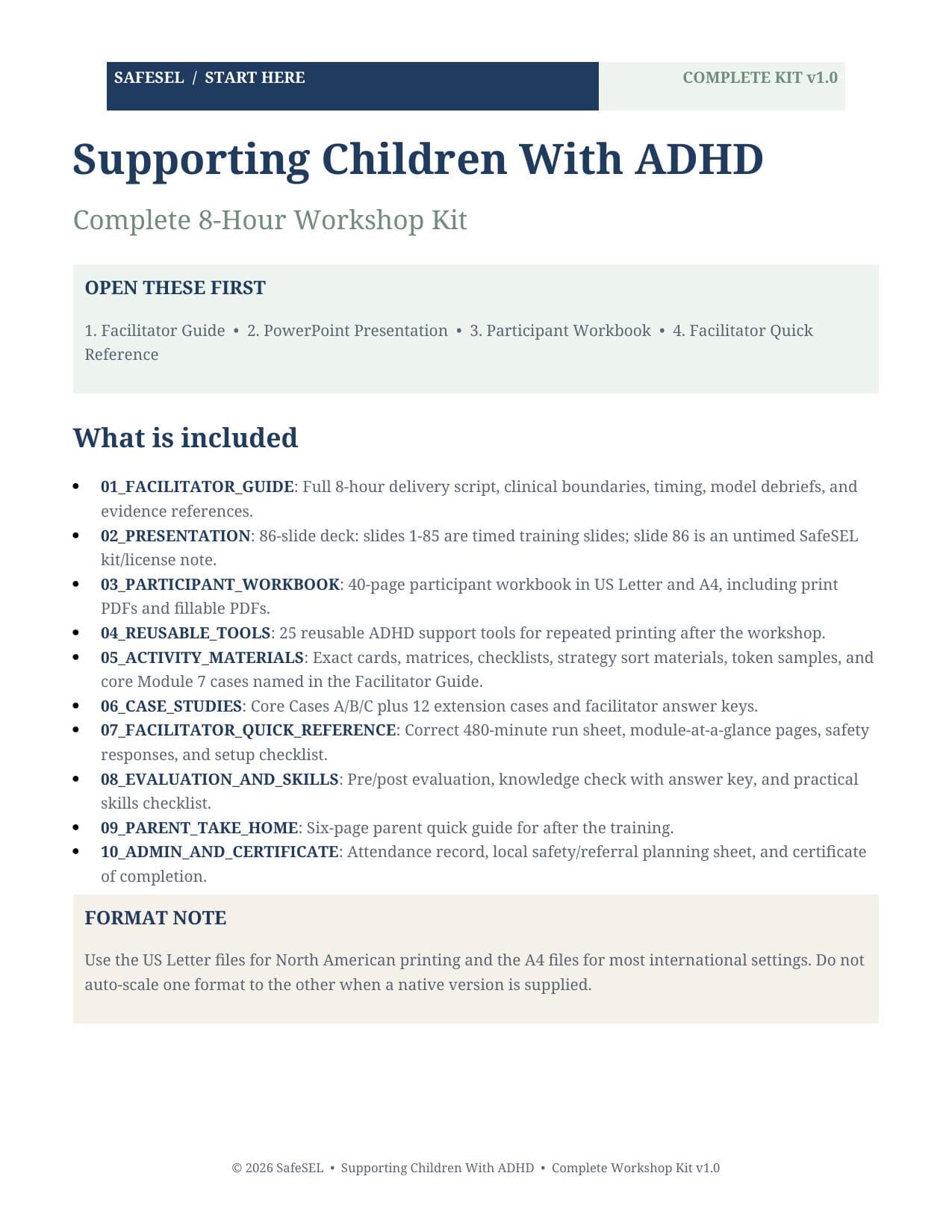
The complete parent education curriculum contains five SafeSEL workshop kits. Its 40 scheduled hours include breaks; it is not 40 hours of accredited continuing education. The purchaser leads the parent and caregiver groups. For one topic, compare individual parent workshops before choosing the complete collection.
Follow up on use, not just enjoyment
A satisfaction question tells you whether people liked the session. Add a learning question: “What would you do first in the fictional situation?” A later optional check-in can ask whether a participant tried the planned step and what got in the way. Do not treat self-reported success as proof that the workshop caused a clinical improvement.
Keep the follow-up proportionate and voluntary. If families need individualized care, provide a route to appropriate support, not a second worksheet as a substitute. For choosing the initial focus, use parent workshop topics for schools. For a broader conceptual sequence across regulation and behavior, read planning a professional workshop on child regulation and behavior.
Related guide: How to Build a Home Support Plan With Separated or Blended Caregivers