An anger and meltdown workshop needs more than a list of strategies. Participants need to understand when an activity applies, what it can teach and when a group exercise should stop. Use fictional examples and clear instructions so caregivers can take part without describing a difficult incident publicly.
The Managing Anger, Meltdowns and Aggression kit supplies facilitator materials for an educational workshop. The activities below are planning examples. They do not replace individualized assessment, safeguarding procedures or crisis training.
Begin with a situation rather than a label
Write a short fictional scene: an activity ends, a child protests and an adult is unsure what to do next. Keep the description limited to observable events. Do not label the child manipulative or ask the group to infer a diagnosis from the scene.
Ask which information is missing. The child’s age, communication needs, the setting and any immediate risk may matter to the next decision. The point is to notice uncertainty before offering advice. Participants should not leave thinking that a short example establishes why a real child becomes distressed.
Activity one: sort actions by timing
Prepare three headings: before the difficult moment, immediate priorities and later discussion. Offer neutral planning statements such as checking the schedule, following the setting's safety procedure and reviewing what information was missing. Ask participants where each statement belongs and why.
Do not turn this into a test with one universal answer for every family. Some statements need more context. Give the group permission to place an item under “we need more information.” The useful learning is the distinction between preparation, immediate response and later reflection.
Keep the immediate-priorities section within your competence. Do not improvise restraint instructions, ask someone to demonstrate aggression or use a workshop example to override an existing support plan. Explain which local procedure applies when someone is at risk.
Activity two: shorten an adult response
Provide a fictional adult response that contains several questions and a long explanation. Ask participants to rewrite it as one brief statement about the next step. They may include an acknowledgement of the feeling if it fits the example, while keeping the boundary understandable.
Participants can write privately, work in pairs or observe. No one needs to perform a distressed child. Ask what changed in the wording and what the revised statement still cannot tell us. A clearer instruction is a communication observation, not proof of a guaranteed outcome.
Activity three: plan a later review
Move to a separate example in which the immediate incident has ended and the people involved are ready for a discussion. Ask the group to write a neutral description, one question about what happened and one preparation step to consider next time.
Keep this separate from demands for immediate apology or forced public remorse. The activity is about planning a conversation, not judging a family. If participants disagree, return to the fictional example and the information available rather than asking whose parenting approach is correct.
Prepare privacy and safeguarding boundaries
Explain at the beginning that personal sharing is optional and that the facilitator cannot promise absolute confidentiality where safeguarding duties apply. Identify a private contact route for concerns. If a participant starts describing an urgent situation, respond according to your role and procedure rather than continuing the exercise as though it were a case study.
Avoid collecting detailed family histories on workshop feedback forms. Ask whether instructions were clear and whether participants know where to seek further support. Keep any operational records according to the setting's actual policy.
Connect activities to the selected workshop format
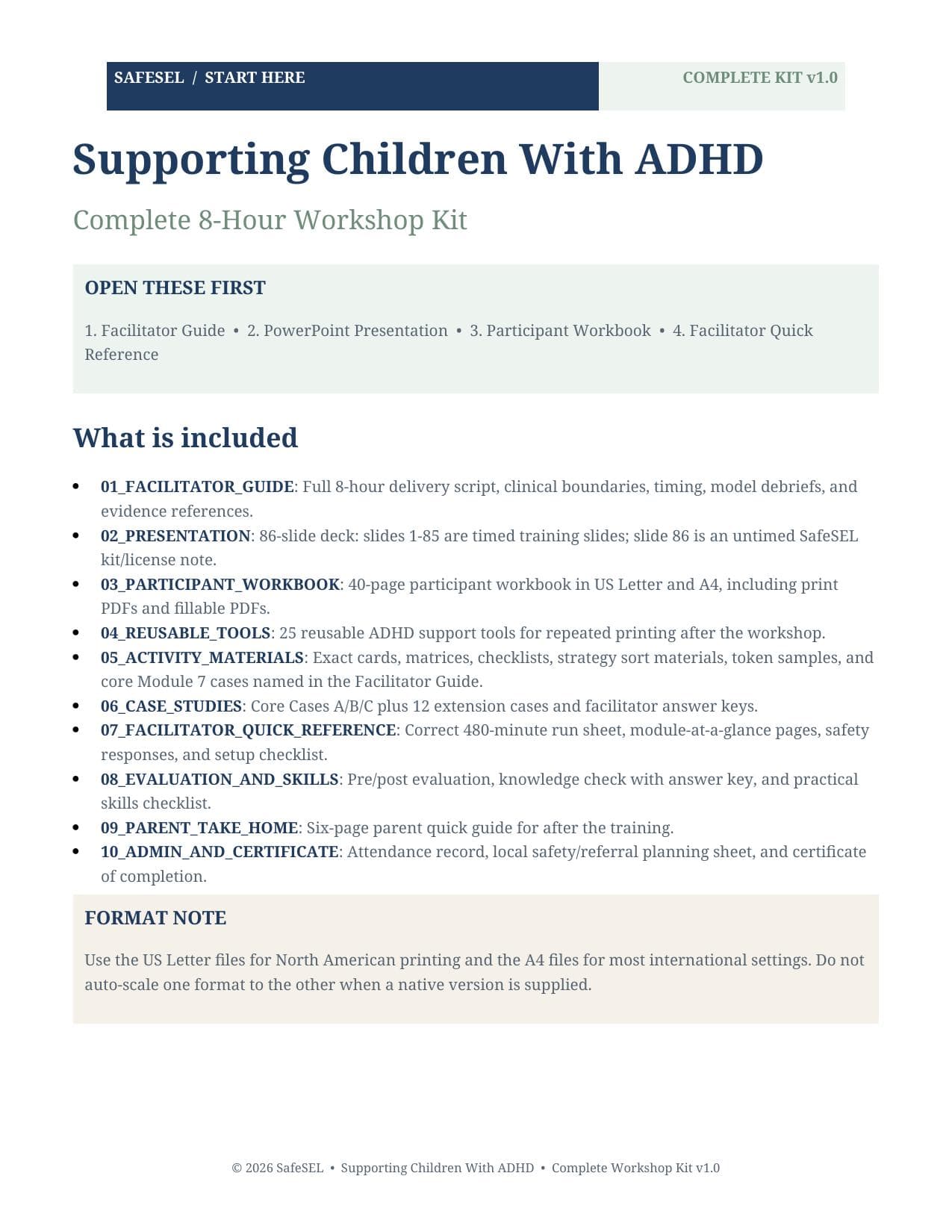
Read the facilitator guide and choose an activity that supports your stated learning goal. Check its workbook page, timing and instructions before delivery. A shorter parent evening can introduce one activity, but it should not be advertised as completing the kit's eight-hour workshop format.
The parent education workshop planning guide helps arrange the meeting. The co-regulation workshop guide offers a related communication activity with a different learning focus.
End with a realistic next step
Invite participants to consider one adult action or one question for their support team. Do not require a public commitment or claim that attendance will eliminate anger or aggression. Educational practice can make a conversation more specific while leaving individual decisions with the appropriate people.
Compare the parent workshop collection to choose a kit around the group's needs. Where serious or continuing concerns arise, make the appropriate referral route clear instead of presenting another worksheet as the complete answer.