Child therapy progress may appear before symptoms disappear. Parents may notice earlier recognition of feelings, more help-seeking, shorter recovery, greater willingness to approach a difficult situation, clearer boundaries, improved participation or less adult support needed. Progress should be reviewed against agreed goals and the child’s wellbeing, not one perfect week.
Return to the actual goals
Ask what therapy is trying to change and how the family agreed to notice it. A broad goal such as “less anxiety” may need concrete indicators across home, school and the child’s own experience.
Notice early and partial change
- Names a feeling or body signal sooner
- Accepts help or requests space
- Recovers in less time after a difficult moment
- Tries a manageable step with support
- Repairs after conflict
- Needs fewer reminders or a lower level of adult help
Expect variability
Progress is rarely a straight line. New demands, illness, transitions and fatigue can temporarily increase difficulty. A setback can still provide useful information, but persistent deterioration needs prompt discussion.
Protect the child from constant evaluation
Do not turn every interaction into a progress test. Use brief scheduled check-ins and include strengths and context. Children need ordinary family time that is not organized around treatment.
Ask for a review when the picture is unclear
Share observations and ask how the therapist is judging benefit, what remains uncertain and when the plan will be reviewed. If therapy is not helping, a careful case review, consultation or referral may be appropriate.
Progress often appears before symptoms disappear
Early change may look like naming a feeling sooner, recovering more quickly, accepting help, attempting a previously avoided task or using less adult support. A child can still feel anxious or angry and be making meaningful progress. Conversely, good behavior in one setting does not by itself show that treatment goals are being met.
Look across four domains
- Awareness: noticing body signs, triggers, thoughts or needs earlier.
- Action: trying a skill, approaching a task or communicating a boundary.
- Recovery: returning to baseline with less time, conflict or support.
- Generalization: using gains outside the therapy room and across people or settings.
Ask the therapist questions that lead to useful answers
- What specific goal are we measuring now?
- What change would be realistic to notice at home or school?
- What support should remain in place while the child practices?
- How will we decide whether to continue, revise or seek another assessment?
- What information can be shared while respecting the child’s privacy and treatment agreement?
Example: progress with remaining need
A child still avoids sleeping alone but now talks about the fear, follows a short evening plan and recovers from setbacks without a two-hour argument. The symptom is not resolved, yet several mechanisms are changing. A balanced review records both the gain and the continuing impairment.
Related SafeSEL guides
Between-Session Practice in Child Therapy — make home practice small and observable
What Can a Child Therapist Share With Parents? — understand parent communication and privacy
Parent Handouts for Child Therapy — support carryover without overload
Distinguish a difficult week from loss of progress
Skills are less available during illness, transitions, family stress, poor sleep or new developmental demands. One setback does not erase learning. Review whether the child recovered, accepted support or returned to the plan more quickly than before. If functioning declines across settings or stays worse, bring that pattern to the therapist rather than increasing home practice on your own.
Parents should also be told when progress is not occurring. A useful clinical review names the goal, evidence, barriers and next decision. Reassuring families that therapy “takes time” without a review point can delay a needed change in formulation, treatment fit, assessment or level of care.
Bring therapist questions that connect therapy progress to daily life
Prepare one example of something easier and one example that remains difficult. Include the help available in each situation. Ask how these observations relate to the current goal and what information would change the plan. This makes a review more useful than asking whether the child is simply ‘better.’
Agree on when to review again and whom to contact if functioning worsens before then. A parent’s observation and the child’s account may differ; both should remain visible. Do not increase practice or remove support solely because one encouraging session seemed to show that the problem was solved.
A practical next step
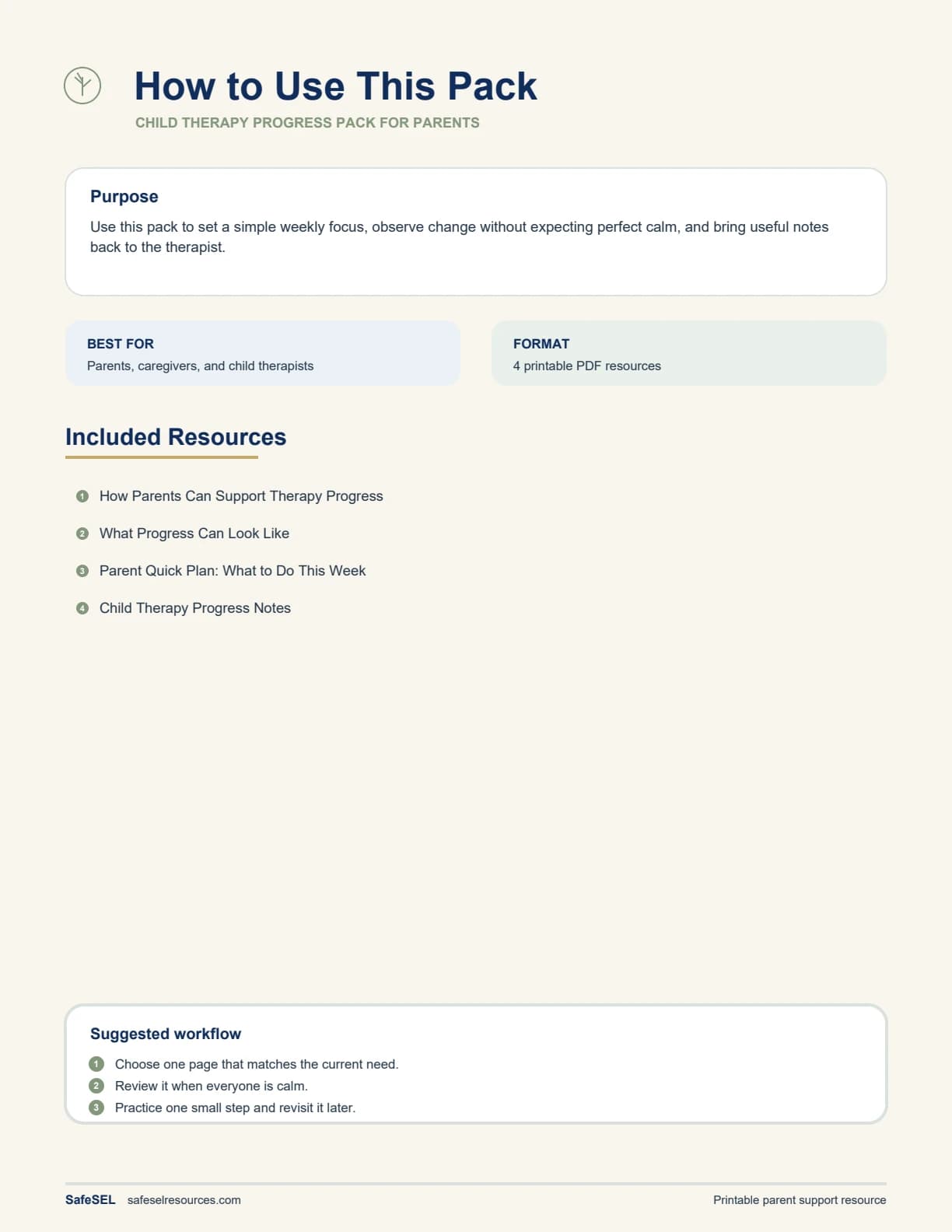
Use brief, balanced home observations with the Child Therapy Progress Pack for Parents.
Browse the complete Parent & Caregiver resource library.
Sources and further reading
- Recognizing When Therapy Has Run Its Course — American Psychological Association (2026)
- About Children's Mental Health — Centers for Disease Control and Prevention (2025)
- Implementation of Measurement-Based Care in Mental Health Service Settings for Youth: A Systematic Review — Clinical Child and Family Psychology Review (PubMed) (2024)